Introduction
The balanced use of modern conveniences is becoming an increasingly important necessity in modern life. As human civilization has progressed, the number of conveniences available to us has continuously increased. Air conditioners, refrigerators, personal vehicles, smartphones, the internet, and many other modern technologies have made life more comfortable and convenient than ever before.
The purpose of these conveniences is to make human life easier. However, maintaining a balance between convenience and necessity is equally important. When the use of a convenience goes beyond necessity and becomes a habit or excessive dependence, it can create economic, social, and environmental consequences.
Today, the need is not to reject modern conveniences but to learn their balanced use. Such an approach makes us more responsible toward resources and encourages a sense of contentment in our lives.
Heat, Humidity, and the Need for Air Conditioning
During summer, temperatures in many regions can reach 45 to 50 degrees Celsius. These conditions often persist for weeks or even months. In such circumstances, the use of air conditioning is both natural and beneficial.
Similarly, during the rainy season or periods of high humidity, temperatures may be lower, yet people can still feel uncomfortable. The primary reason is increased humidity in the atmosphere.
The human body cools itself by producing sweat. Under normal conditions, sweat evaporates and helps remove excess heat from the body. However, when humidity levels are high, sweat evaporation slows down, reducing the body’s natural cooling effect. As a result, people experience discomfort, stickiness, and fatigue.
In such situations, air conditioners do more than lower temperature; they also regulate humidity, creating a more comfortable indoor environment. Therefore, the balanced use of modern conveniences does not mean avoiding their use altogether. Rather, it means using them according to actual needs and circumstances.
The Difference between Comfort and Excess
People generally prefer an environment that is neither too hot nor too cold.
For most individuals, temperatures between 24 and 28 degrees Celsius are considered comfortable, although personal preferences and local climate conditions may vary.
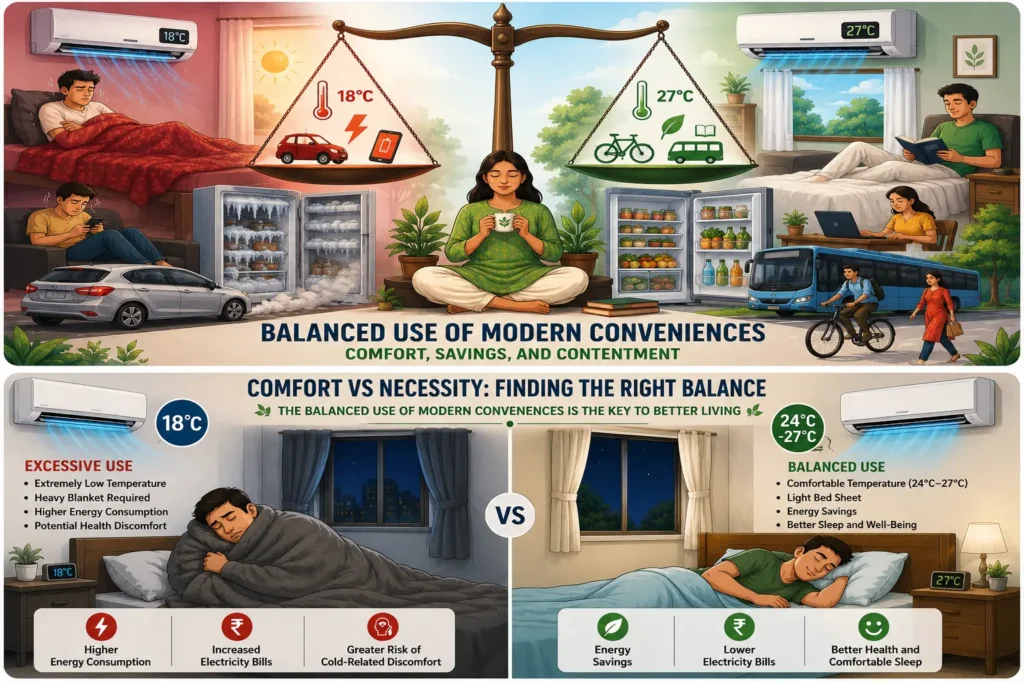
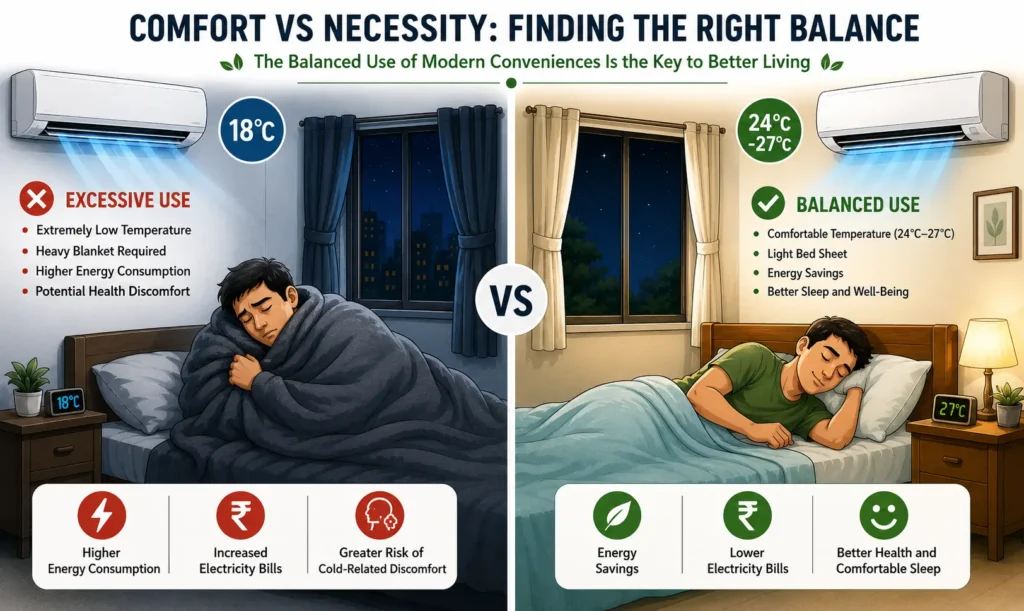
The problem arises when we continue lowering the temperature even after achieving comfort. Many people set their air conditioners so low that they require thick blankets while sleeping.
This raises an important question: if the same comfort can be achieved at a slightly higher temperature with a light cotton sheet, why create excessive cooling in the first place? The balanced use of modern conveniences encourages us to reflect on such choices.
Convenience or Overconsumption
This is not merely a question of saving electricity; it is also a question of how we approach convenience.
If a person can sleep comfortably at 27 degrees Celsius, lowering the temperature to 18 or 20 degrees and then covering oneself with a heavy blanket becomes an unnecessary additional process. We first create excessive cooling and then take further measures to counter its effects.
The purpose of convenience is to simplify life, not to create situations that require additional solutions. The balanced use of conveniences helps us understand that there is a limit between comfort and excess comfort.
Why the Balanced Use of Other Conveniences Matters?
The principle of balanced use of modern conveniences is not limited to air conditioners. Many other conveniences in daily life require the same approach.
For example, refrigerators are equipped with temperature controls. During winter, when outdoor temperatures are already low, the refrigerator setting can often be adjusted accordingly. This reduces electricity consumption and places less strain on the appliance.
Similarly, refrigerators should be defrosted regularly. In many households, ice accumulates to such an extent that the defrost compartment cannot function properly. This increases energy consumption and may reduce the appliance’s efficiency.
Through such simple practices, the balanced use of conveniences can be applied in everyday life.
Balance in Transportation
Personal vehicles have made travel highly convenient. However, using them for every short-distance journey is not always necessary.
Whenever possible, public transportation can be a practical alternative. Today, buses and trains offer a wide range of modern facilities, including air-conditioned coaches, sleeper services, and various comfort levels that make travel more convenient than before.
The balanced use of transportation options can reduce personal expenses while also helping decrease traffic congestion, fuel consumption, and environmental impact. This is another practical example of the balanced use of modern conveniences.
Balance Is Not Only About Possessions but Also About Their Use
The balanced use of modern conveniences is not limited to what we own; it also depends on how we use those conveniences. Different people have access to different facilities and resources, but using them responsibly and in moderation is a shared responsibility.
For example, personal vehicles have become an important convenience in modern life. They make travel faster, more comfortable, and more efficient. However, using a vehicle also requires balance and responsibility.
Many people develop the habit of honking unnecessarily, especially in large cities where excessive horn use has become a common sight. The purpose of a convenience is to make life easier, not to create inconvenience for others or contribute to environmental pollution.
Similarly, maintaining a balanced driving speed is important. Excessive speed can increase the risk of accidents and may result in the loss of life and property. Driving is necessary, but driving at a reasonable and controlled speed is equally important. A balanced approach to driving can improve safety and may also help reduce fuel consumption.
Vehicles are equipped with a speedometer that shows the current speed of the vehicle. In many vehicles, there is also an average or economical operating range that indicates a speed at which the vehicle can run more efficiently.
Driving within this range may help save fuel while also reducing the risks associated with excessive speed. In this sense, the speedometer can be seen as a reminder of balance. It teaches us that faster is not always better.
In reality, most inventions are created to solve problems and improve human life. We have successfully developed countless tools, machines, and conveniences, but learning how to use them in a balanced manner remains our responsibility. Creating a convenience is an achievement of science and innovation; using it wisely is a responsibility of society.
The same principle applies to food. Health experts often recommend a balanced diet because food is essential for life, but balance in both quantity and quality is equally important. Excessive consumption can create health problems, while a balanced diet provides the nourishment the body actually needs.
Ultimately, balance should exist not only in the things we possess but also in the way we use them. When we bring balance to our resources, habits, and behavior, life can become safer, more effective, and more satisfying.
Managing Screen Time
In the digital age, screens have become an integral part of everyday life. Education, work, and entertainment increasingly depend on digital devices.
However, convenience remains beneficial only when used in moderation. Excessive screen time can place strain on the eyes and reduce physical activity.
Therefore, it is important to establish reasonable limits on screen use for entertainment and other activities. Taking regular breaks and allowing the eyes to rest are simple yet effective steps toward balance.
When digital tools are used wisely, the balanced use of modern conveniences becomes more than an idea—it becomes a lifestyle.
The Relationship between Balance and Contentment
The balanced use of modern conveniences is not merely about managing resources; it is also closely connected to contentment.
It is natural for people to pursue progress, acquire new conveniences, and improve their standard of living. However, every fulfilled desire often gives rise to new desires. This is why contentment remains important.
Many people build larger homes than they actually need, create more rooms than they will use, or purchase items that serve little practical purpose. Over time, such possessions become collections rather than genuine necessities.
This does not mean that conveniences or property are wrong. The real question is whether they align with our actual needs. The balanced use of conveniences teaches us how to maintain harmony between necessity, utility, and contentment.
Benefits of Balanced Use
The balanced and responsible use of conveniences offers several benefits:
- Reduced electricity and energy consumption.
- Lower unnecessary expenses.
- Less strain on appliances and equipment.
- Reduced environmental impact.
- More responsible use of resources.
- Greater self-discipline and contentment.
In this way, the balanced use of modern conveniences can benefit individuals, society, and the environment alike.
Conclusion: The True Meaning of Convenience
Modern conveniences are among humanity’s significant achievements. Their purpose is to make life safer, more comfortable, and more productive. The problem does not lie in conveniences themselves, but in their excessive or unbalanced use.
The balanced use of modern conveniences is not about sacrifice; it is about wisdom. When we understand the difference between necessity and excess, we can lead lives that are simpler, more balanced, and more fulfilling.
In my view, true prosperity is not measured by the number of conveniences we possess, but by our ability to use them responsibly and appropriately. When a convenience is used according to need, it becomes a source of comfort. When overused, it can become a source of unnecessary dependence.
Ultimately, the balanced use of modern conveniences teaches us that it is possible to enjoy the benefits of modern life while maintaining contentment, responsibility, and good judgment. Such balance is essential for personal well-being, resource conservation, and the long-term benefit of society.
There is a close connection between the balanced use of modern conveniences and our overall lifestyle. If you would like to explore how modern habits and changing lifestyles may influence the natural rhythm of human life, you may also read our article, “Is Human Life Span Becoming Irregular?”